Current global sales of semaglutide exceed US$1 billion per month. Our research on GLP-1 is also in full swing. Novo Nordisk’s compound patent protection period for smeglutide in China is until 2026. At present, many companies' semaglutide analogues have entered the Phase III clinical stage, and research on GLP-1 small molecules is also very active.
Semaglutide, also known as semaglutide, is a glucagon-like peptide-1 (GLP-1) analog. The sequence is as follows. Molecular formula: C187H291N45059, as a long-acting GLP-I receptor agonist, only needs to be injected once a week. It can be used to assist diet control and exercise to improve blood sugar control in patients with type 2 diabetes, and can also reduce the patient's weight.
The current synthesis methods of semaglutide include patents: CN 106928343 A, CN 101133082 A, and CN 106478806 A. The Fmoc strategy is used to synthesize semaglutide through solid-phase stepwise coupling. In this method, amino acids are gradually coupled to the synthesis cycle, the reaction is incomplete, the solid-phase carrier is limited by the substitution value, the overall yield is low, and there are many impurities, making purification difficult (reason: during the gradual extension process of the peptide chain, intermolecular and molecular The aggregation and folding within the peptide significantly hinders the deprotection and coupling steps, thereby producing many by-products and reducing the purity of the target peptide). Patent: CNl 06749613 A It is synthesized by solid-phase fragment condensation method. The synthesis of solid-phase fragments requires long steps, is not easy to amplify, wastes solvent, and produces a large amount of waste liquid.
First, 6 side-chain protected peptide fragment sequences are synthesized through solid phase and liquid phase, and each peptide fragment is gradually coupled in the solid phase to obtain a fully protected semaglutide linear polypeptide. The peptide fragments are first synthesized for purification, which can greatly reduce In the end, the impurities produced by racemization, oxidation, and hydrolysis of semaglutide products greatly reduced the scope of impurity research during the synthesis of raw materials, saving time and costs, and short peptide fragments synthesized in liquid phase and solid phase can be synthesized by conventional methods. Rapid purification, the purity can reach more than 99%, without the need for preparative HPLC purification, saving solvents and reducing the cost of later purification. Since multiple fragments can be synthesized at the same time, and easy to scale up production, solid-phase synthesis does not need to couple amino acids one by one. The steps of solid-phase synthesis are reduced, the synthesis efficiency is improved, and the generation of waste liquid is reduced. In the final liquid chromatography purification step, the impurities are not missing peptides lacking one or several amino acids, but uncondensed partial fragments. It will not cause difficulties in purification, has high efficiency, low cost, less waste liquid, easy purification, and is suitable for large-scale production.
Among the 6 side chain protected peptide fragment sequences, Asp, Phe, and Gly are placed at the first position at the carbon end of the peptide fragment sequence, which improves the condensation efficiency of amino acids and effectively avoids Trp, Ser, Val, Ile, and Arg as The first position of the carbon terminus affects the condensation efficiency, effectively avoids β-sheets in solid-phase synthesis, and improves the purity and yield of semaglutide;
The specific synthesis process is as follows:
The first step: Couple the carboxyl end of the side chain-protected sixth peptide fragment sequence with the resin and remove its amino protecting group;
Step 2: Couple the side-chain-protected sixth peptide fragment sequence obtained in the first step with the amino-protecting group removed and the side-chain-protected fifth peptide fragment sequence to obtain the side-chain-protected seventh peptide fragment sequence, and remove the amino-protecting group. Its amino protecting group;
Step 3: Couple the side chain protected seventh peptide fragment sequence with the amino protecting group removed and the side chain protected fourth peptide fragment sequence to obtain the side chain protected eighth peptide fragment sequence, and remove its amino protecting group. ;
Step 4: Couple the side chain protected eighth peptide fragment sequence with the amino protecting group removed and the side chain protected third peptide fragment sequence to obtain the side chain protected ninth peptide fragment sequence, and remove its amino protecting group. ;
Step 5: Couple the side chain protected ninth peptide fragment sequence with the amino protecting group removed and the side chain protected second peptide fragment sequence to obtain the side chain protected tenth peptide fragment sequence, and remove the amino protecting group. ;
Step 6: Couple the side-chain-protected tenth peptide fragment sequence with the amino protecting group removed and the side-chain-protected first peptide fragment sequence to obtain a fully protected semaglutide linear polypeptide;
Step 7: Remove the side chain protection of Lys at position 26 from the fully protected semaglutide linear polypeptide, and complete the modification to obtain fully protected semaglutide;
Step 8: Cleave fully protected semaglutide to remove the protecting group to obtain crude semaglutide peptide;
Step 9: The crude semaglutide peptide is purified and salted to obtain semaglutide.
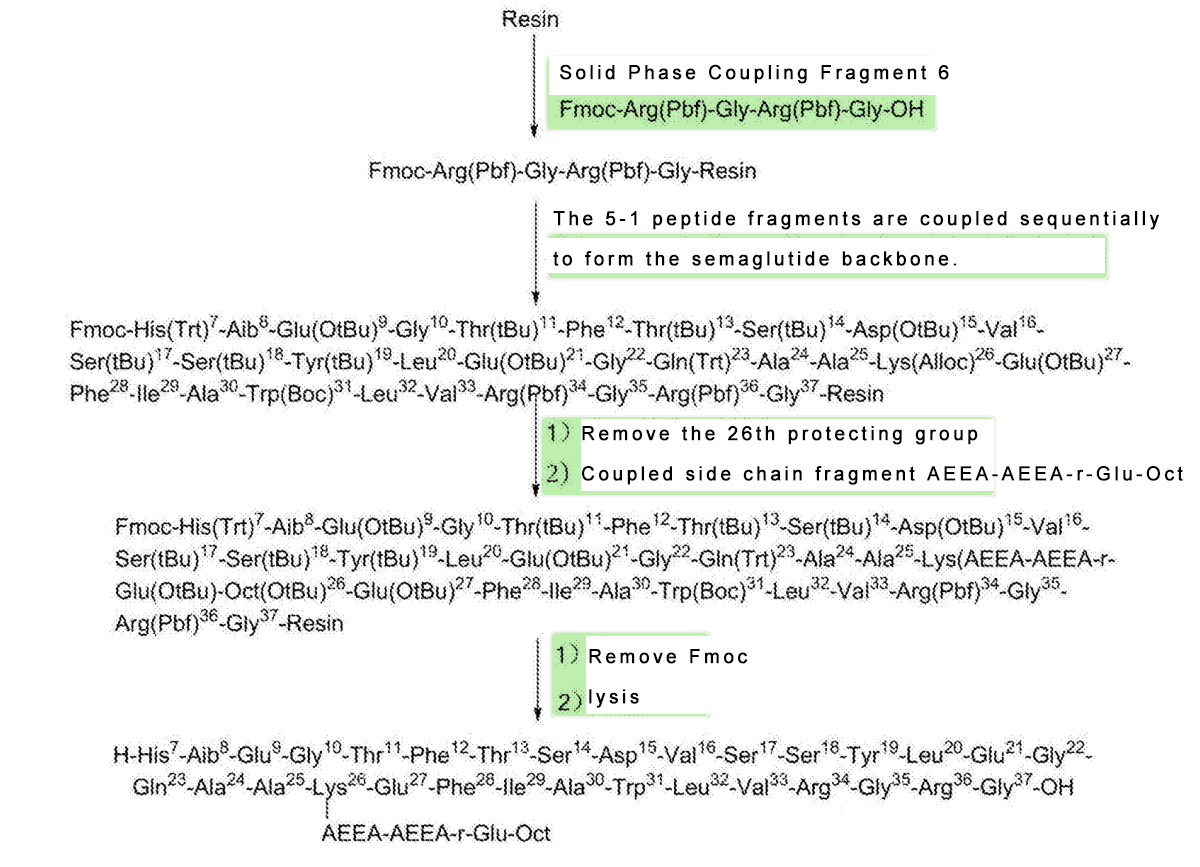
By pre-synthesizing the first peptide fragment sequence to the sixth peptide fragment sequence, and then stepwise coupling in the solid phase to obtain semaglutide, in the final liquid chromatography purification step, the impurities are not missing peptides lacking one or several amino acids. , but uncondensed partial fragments, only need 1-2 times of preparation and purification, and the product purity reaches more than 99.5%, while the usual synthesis method requires 4-5 times of preparation and purification, which greatly improves the purification yield. The product synthesized by this method The purity of crude semaglutide can reach more than 75%, while the traditional synthesis method can only reach 60%; the total yield of semaglutide after preparation and purification can reach more than 60%, which greatly reduces the production of semaglutide. cost.


